

In His Corner: The Power of Advocacy and Empathy
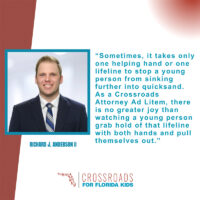
By Richard Anderson II, McGlinchey Stafford, PLLC
Recently, through my involvement with Crossroads For Florida Kids, I was appointed as Attorney ad Litem for a young man involved in delinquency proceedings in Juvenile Mental Health Court. Together, we successfully navigated the guidelines of his Case Resolution Contract, resulting in a dismissal of the charges he was facing.
This young man was referred to Crossroads just before his 17th birthday because his case was not progressing successfully and the court identified a need for additional support. The referral noted that he was adopted and had significant mental health concerns. He no longer felt his adoptive parents were acting in his best interests in court, and he resisted complying with his case plan, including mental health treatment.
Like many who are aging out of the dependency system, he faced tremendous trauma in his early youth. Before Crossroads’ involvement, he had developed a reputation for obstinance and a mild disdain for authority. These factors led him into the delinquency system and left him with the impression that authority figures, whether in schools, law enforcement, or even at home, were working against him. Importantly, the first time we met, I made it clear that I was there to represent him and him alone, and that I would always be in his corner—no matter what.
As a team, the Crossroads attorneys approached his situation with empathy. His behavior wasn’t unacceptable; it was an understandable outcropping of years of trauma. Rather than offering more admonishment, we formed an immediate connection based on unwavering support and confidence in his ability to find solid footing as he approached adulthood. Through persistence and dedication, we built a relationship of trust, open communication, and mutual respect. We shared life stores, discussed the meaning of past trauma, and planned for his future.
As with anyone, missteps occurred—and will continue to occur. But through our involvement, he has found the ability to give himself grace. Instead of allowing setbacks to spiral and derail progress, he now understands that missteps are part of personal growth. Together, we embraced the idea of “turning a negative into a positive” by learning lessons that help avoid repeating mistakes.
Although his case has concluded, we remain connected through near-daily text messages, FaceTime calls, and lunch every few weeks. It is clear that our support has made a meaningful impact on his life. Most importantly, he has come to realize that the old trope that you “cannot change the past” is untrue. The events remain, but their meaning can change. Rather than lamenting his experiences, he has transformed them into sources of strength and confidence.
This shift in focus from the negative—lamentation, admonishment, excuses—to the positive—vision, goal setting, solutions-oriented thinking—has allowed him to see a future for himself. He is now repairing his relationship with his adoptive parents, catching up on school credits, surrounding himself with positive peers, and working nearly full-time.
It is doubtless that our involvement has caused a paradigm shift. We hope our continued support will have a positive impact not only now, but for decades to come. Sometimes, it takes only one helping hand or one lifeline to stop a young person from sinking further into quicksand. As a Crossroads Attorney Ad Litem, there is no greater joy than watching a young person grab hold of that lifeline with both hands and pull themselves out.
